
How lucky are we to have a coconut palm in our back yard! Is there any more ubiquitous emblem of an island paradise?
Our palm’s fronds click in the breeze, reminiscent of rain on a tin roof, but ever so soft. It drops two or three baby nuts a day for most of the year, a steady source of snacks for River.

In the winter, though, when laden with fruit, it grows deadly, threatening to drop 10-pound, rock-hard bombs on our heads from 35 feet above. When one falls, the whump can wake you up at night.
That’s when you call a palm trimmer.
The non-gentle (typical) approach to coco palm trimming
Our landscaper, who we value for his broad knowledge of island plants and trees, brought down the big coconuts for us the first couple of years. *He has the dubious distinction of having been knocked unconscious by a falling coconut. Yikes.
He takes the typical approach of most coconut trimmers on Maui:
- straps on spiked boots, hangs several machetes on his tool belt, and gathers his safety rope
- climbs the stem by jabbing spikes into it
- hacks the fronds with machetes, letting the fronds free-fall to the ground
- hacks the stem of the coconut clusters with machetes, letting the bunches drop from their height. Like balls on a pool table after a good break, coconuts scatter in every direction. A few nuts crack.
- tidies the trim by hacking off the bits of paper covering the stem and letting them fly
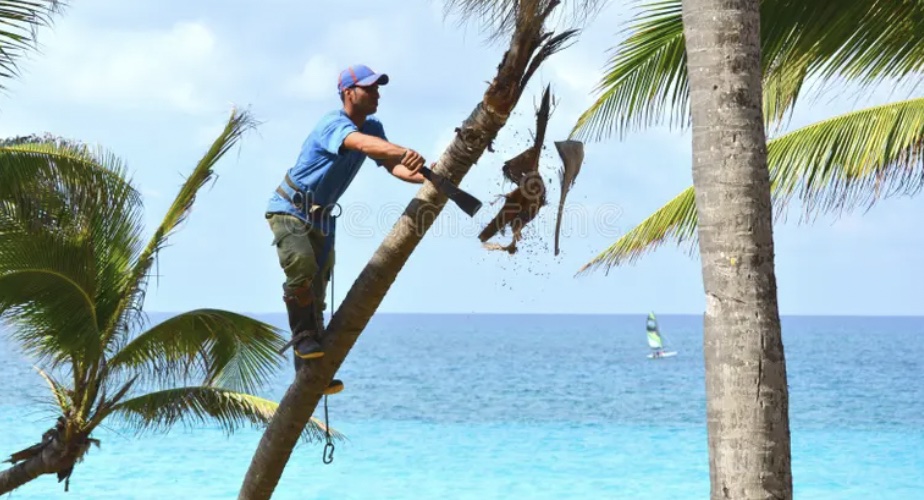
It is hot, exhausting, and dangerous work, and the men who do it for a living are rightfully proud of their skill , strength, and stamina. There is a lot of coco trimming work to be had on Maui because neither county parks nor resort properties (nor many homeowners) want anyone killed by a falling coconut.
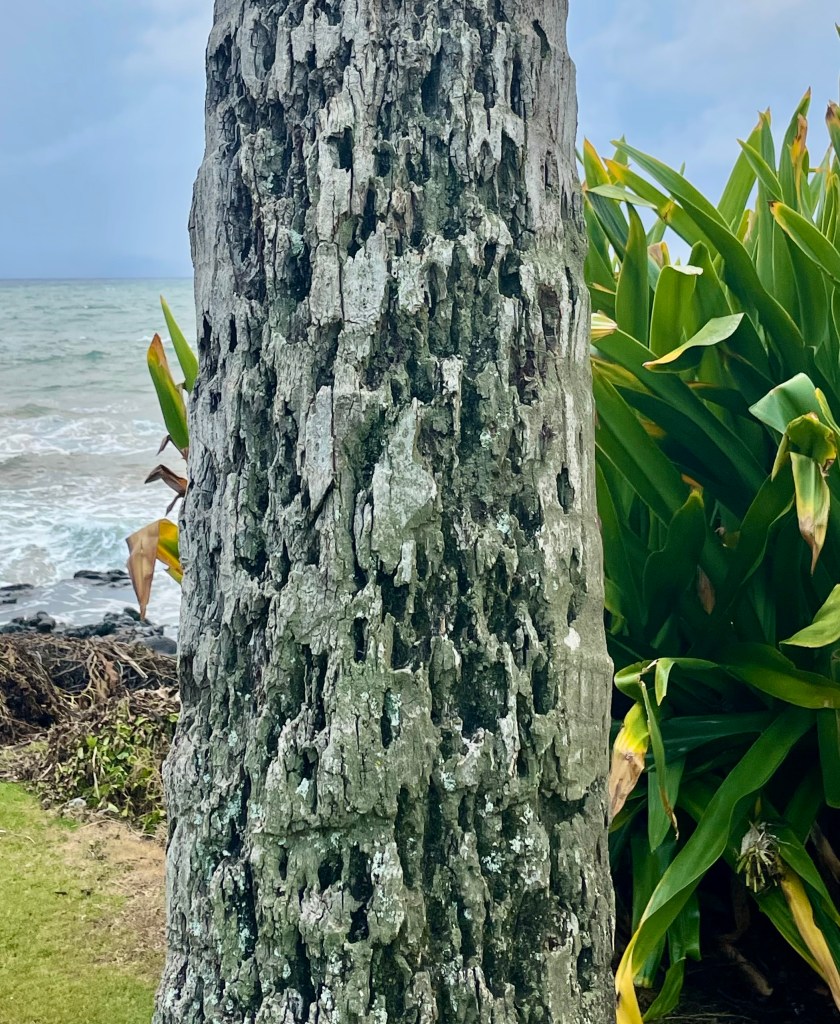
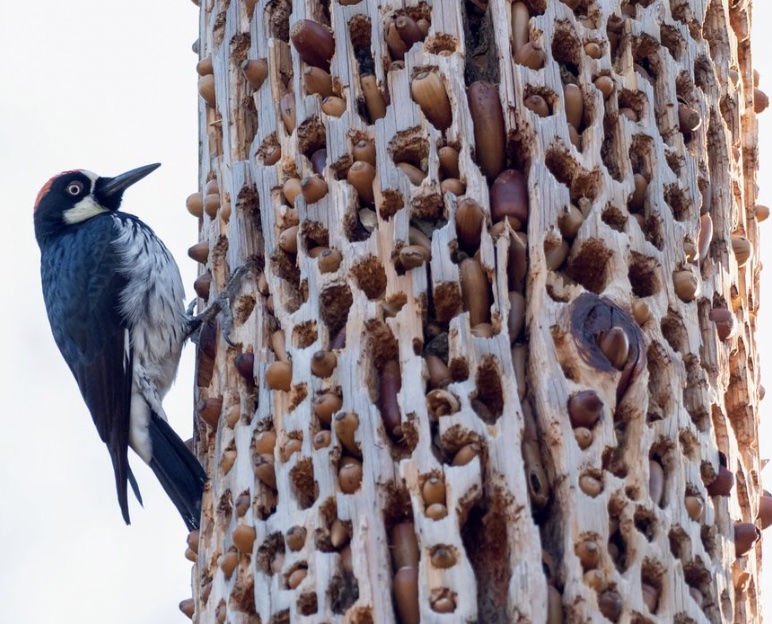
This winter we decided to take a spike-less approach. Our tree already has a few spike scars, and we didn’t want it to end up looking like a resort palm in its old age. Their stems become as holey as a woodpecker’s granary tree (a reference you’ll get if you’re from NorCal, as I am).

Through an acquaintance, we learned of Taona (pronounced Ta’ona with the glottal stop of the ‘okina consonant) Fiederer-Sheppard. Taona grew up in Haiku, scaling coco palms barefoot for fun, just to pick a few nuts for his family. His mom wisely advised him to get training in proper (i.e., safe!) spike-free scaling and harvesting.

A gentle man’s approach
Wearing regular boots, Taona laded himself with a standing platform and a smaller bench platform, a safety rope, rigging tools to capture the clusters of nuts, several saws (no machetes), and a large cloth bag to capture the paper trimmings. He scaled the tree, strapped the standing platform to it, and began.
He worked methodically–
He sawed each frond. caught it before it fell, swung it to line it up to the pile, and dropped it. *Fronds are not frond-like. They are heavy, sinewy, as dense as wood, and hard to cut through–hence the machete scars on most trees.
He rigged up each bunch of coconuts so that when he cut the stem, he could drop the bunch slowly, the way a tree trimmer eases a heavy cut safely to the ground.
He used small saws to trim the paper close to the stem, then tucked the wads into his bag to save for compost.
He maneuvered the platform with his feet, putting me in mind of an agile longboarder hanging ten.
He checked for signs of the Coconut Rhinoceros Beetle, a scourge that can decimate palm plantations. A threat to palms is a threat to Hawaiian culture and island way of life. *https://www.mauicounty.gov/2767/Coconut-Rhinoceros-Beetle-Threat#:~:text=The%20CRB%20doesn’t%20just,impacts%20Native%20Hawaiian%20cultural%20practices. Luckily, no sign of beetle.
Digging into the dusty mess up in the tree, he said, “It’s a whole farm up here, all this fertilizer, homes for the birds. I hope they can keep the beetles away.”

These still-green nuts contain no meat to speak of, but each will offer a cup or two of tasty water. Taona took them home as part of his reward.
When he finished, he took time to show us how to shred the paper and lay it around our banana plant as compost–“a home for the bugs and worms and bacteria.”
Before descending from his perch, he smiled down…
“I love this palm.”
We all felt the love, including the palm, I’m sure.

 All play and no work
Leave a reply to Lindy Cancel reply