
DISAPPEARING EDDIES, GETTING THE WOBBLIES, AND OTHER MAGICAL MOMENTS AT THE EQUATOR
Latitude 0º 0′ 0″ is a cool place for a photo.
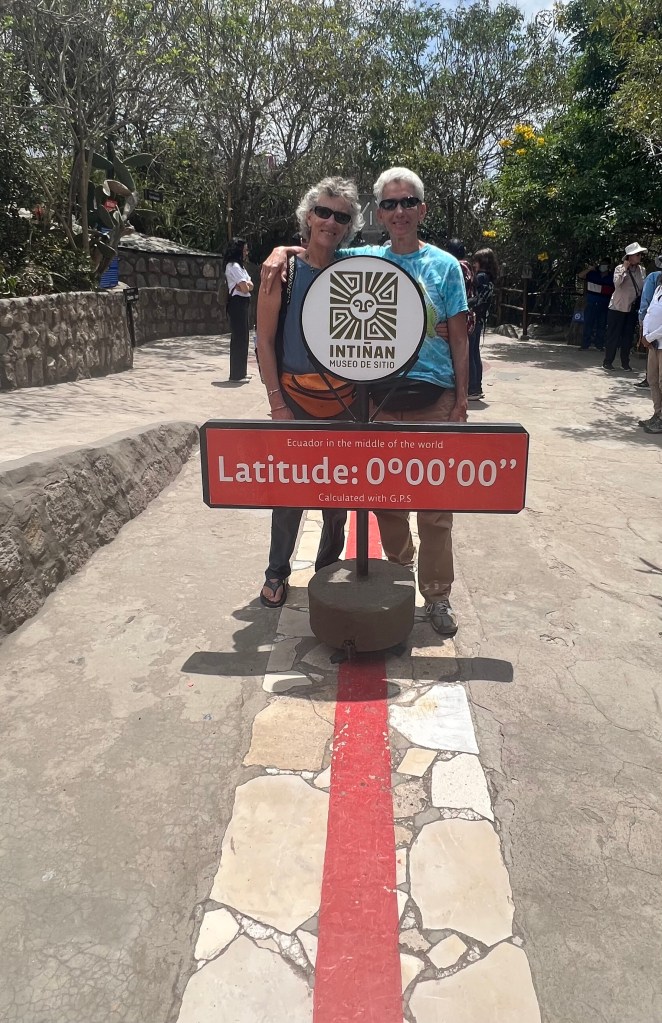
But much better, it’s a place where your own senses teach you about the two hemispheres and the seemingly magical qualities of the exact point that divides them.
The Intinan Museum
At over 8,000” elevation and very close to the equator, Quito is the city closest to the sun. The Intinan Museum, just a few miles from the city, features a stripe of paint that marks the equator.
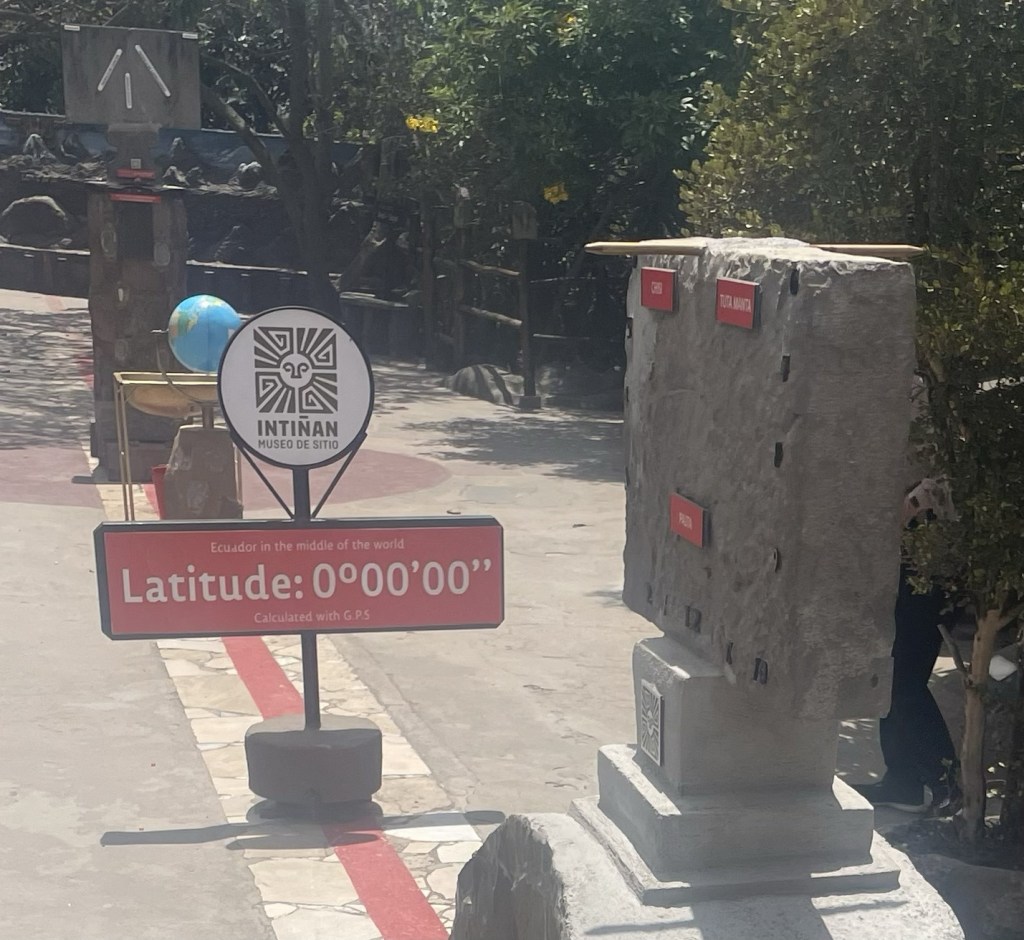
When we got there, we wondered— is this narrow painted stripe actually, exactly at the equator? (And…how do “they” know??) By the time we left, our eyes and our whole bodies had seen and believed!
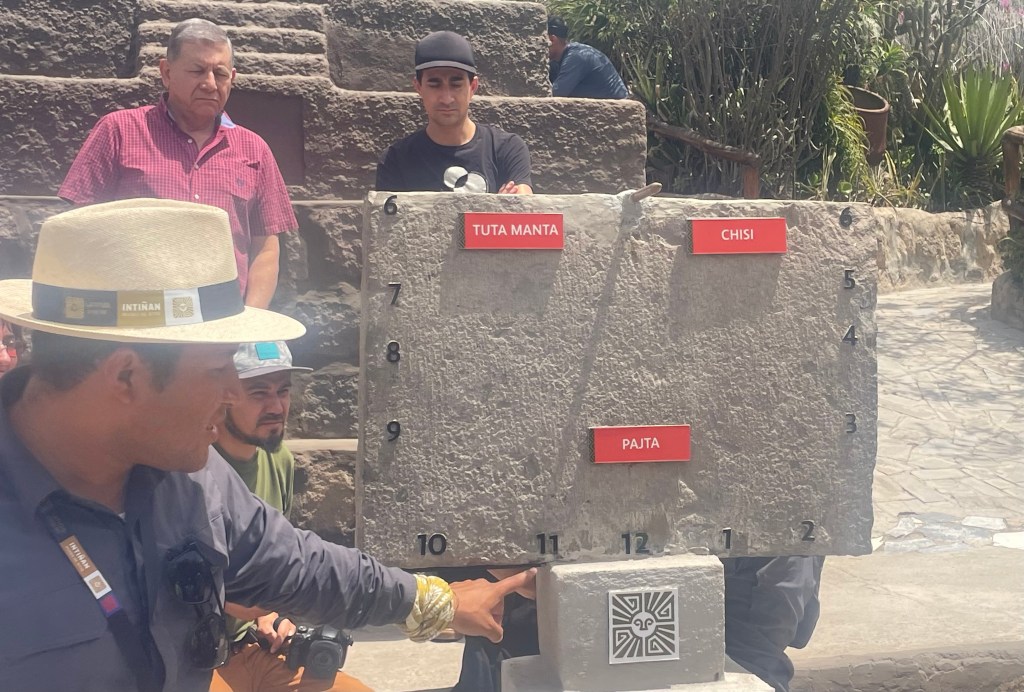
A two-faced sundial
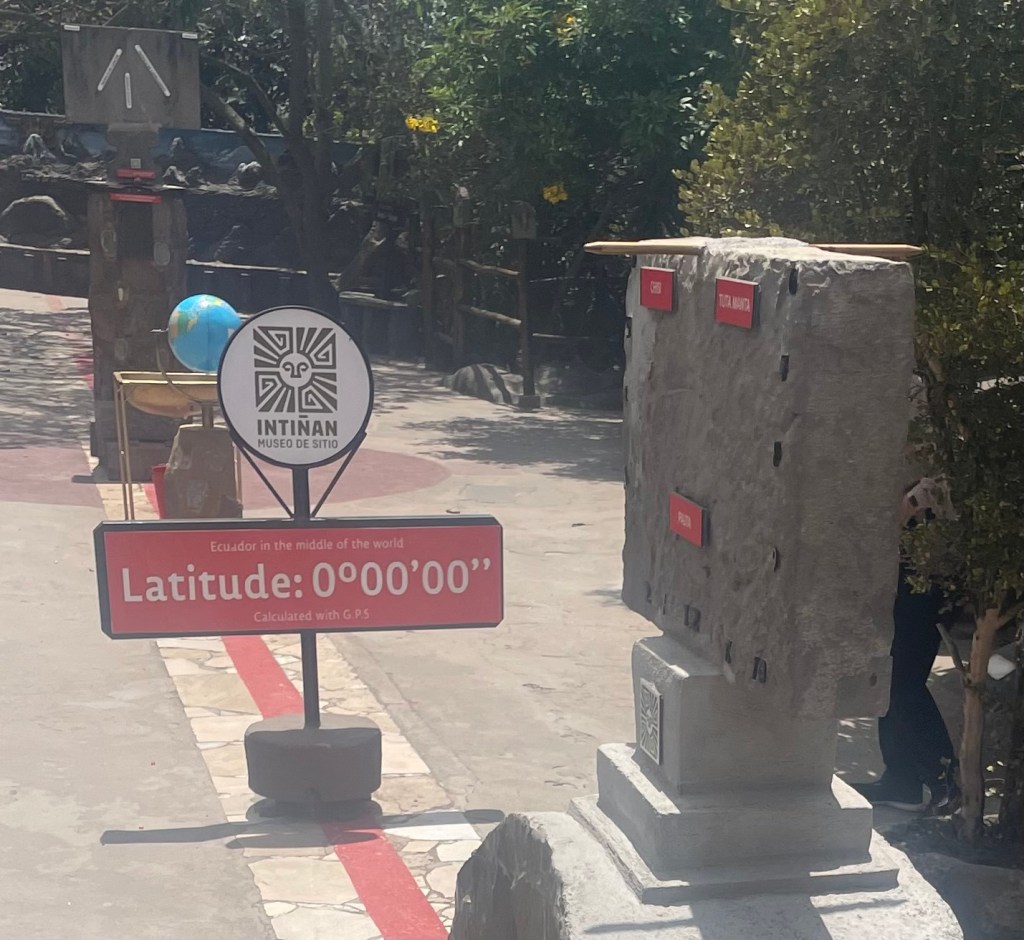
A two-faced sundial verifies the position of the sun at the equator. At noon at the spring equinox, there is no shadow at all; then a shadow begins to appear on the north face. At the fall equinox, after a few minutes at noon where there is no shadow, the shadow creeps to the south face of the dial.
Since we are here a few days after the fall equinox, we don’t get to see this ourselves. But we do see that one side of the dial is fully in shadow, and at 11:25am, the dial is accurate on the south side.
(Non)Spinning water
We learn in school that hurricanes in the northern hemisphere spin counter-clockwise and typhoons in the southern hemisphere spin clockwise. Wherever we live, we observe the spin of clouds on weather maps, and if we’re attentive to our surroundings, we feel the direction of the winds.
So…what happens at the equator? Check out this video!
This is why people living on the equator experience neither hurricanes nor typhoons.
But here is the TRULY MIND-BLOWING discovery: less than 10 FEET in either direction of the equator—north or south—the water WILL SPIN.
This video is from 10 feet north of the line.
And this one, 10 feet south.
Witnessing this was such a WOW! All in our group—even the science-centric folks—were flabbergasted at the immediacy of the hemispheric effect. The equator is not a swath; it is a THIN invisible line that marks changes in behavior.
The standing egg
Ever try to stand a raw egg on its end? Don’t waste your time trying unless you’re at the equator. There and only there—on the exact line of non-eddying liquid—you can balance an egg on the head of a nail!
It’s not easy—only 3 in our group of 10 did it within the couple of minutes we could tolerate standing in the noonday sun. One of them was Amy!

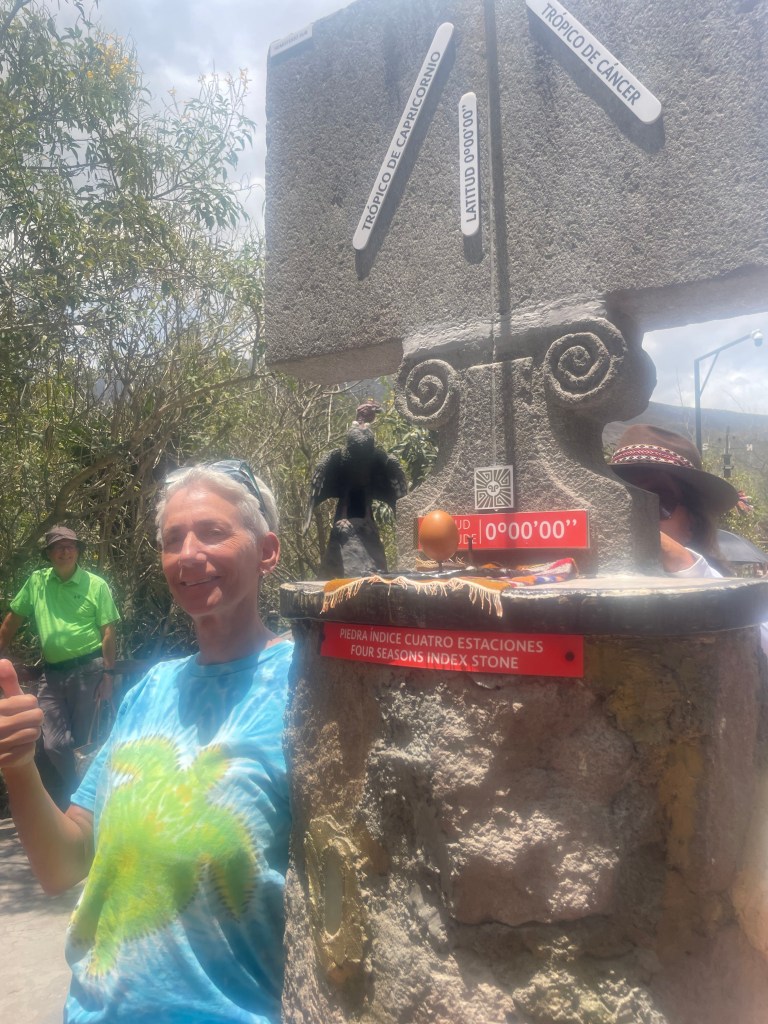
And she got a certificate to prove it 😁

At the equator the liquid yolk settles quickly to the lowest point of the oval and becomes still. The liquid egg white is still; it does not swirl the yolk one way or the other.
Your ability to stand the egg on the nail is governed by your touch and your eye, not by the behavior of the fluids in hemispheric condition. Stillness = balance-ability.
Feeling tipsy!
We were invited to stand with both feet on the painted equator line, extend our arms to the side for balance, lift our chin to look straight ahead, close our eyes, and step forward, toe-to-toe.
Well, as soon as we closed our eyes, we began to wobble, having lost the proprioceptive advantage of sight. This way and that, like comic strip drunks, we tried to walk, soon stepping off the line one way or the other. *
* We were so busy staggering, laughing, and cheering one another on, we took no photos! Darn! But our guide, Pablo, did. In his documentary video https://www.youtube.com/watch?v=nbdgKCUmtdQ , go to minute 2:12 to enjoy our equatorial antics.
Then we moved ONE METER south of the equator and did the same thing. What would happen, if anything? When we closed our eyes, we wobbled…but this time, when we lost our balance, we stepped off to the south! We felt a distinct pull only in that direction.
WHAT???
Then we moved ONE METER north of the line and assumed the balance position. This time I told myself, “Ok, hold it together! Don’t fall to the north!” Starting just a meter off the equator couldn’t really matter…could it?
Wobbling away we went, fighting for balance, trying to step, until ultimately we all stepped off the line—to the north.
WOW…
Amy pointed out that the cement floor was not perfectly flat, but instead ran very slightly downhill toward the south. (Seriously, there may be zero flat space available in the entire Ecuadorian Andes.)
With her physical therapist background, she wondered if the initial falling off to the south was caused by the slope. But when we all fell uphill to the north, it was clear that the hemispheric pull was stronger than gravity.
The Coriolus effect: FEEL IT TO BELIEVE IT!

Indigenous discovery of the equator
“Intinan” (accent on the first syllable, tilde ~ on the first n) is Kichwa language for “path to the sun.” Like many other indigenous peoples around the world, the Quitu people studied, marked, and came to understand the movement of the sun centuries before scientists sent by colonizing nations.
Unlike most other groups, though, the Quitu people found a location within their homeland where —on two days of the year, for a few minutes—the sun left NO SHADOW. They also observed that at this place, the length of time between sunrise and sunset was equal all year round. Over the centuries the name of their group, Quitu, came to mean “half the earth.”
Unfortunately, the conquering Inca peoples destroyed the Quitu sun dials. 🙁 And then the Spanish destroyed and covered up the Inca temples. 🙁 Only one Quito sun monument survives and is not well preserved.
Modern science continues the discovery process
As a species we seem to have an innate capacity, and desire, to understand our world. Over the millennia, disparate groups of people have measured the path of the sun*, and located the equator, through careful observation. Only recently have the tools of science evolved to verify and elaborate upon indigenous understandings.
*you might enjoy my post, “Temples of the Sun…”
In the mid 1700’s, Spanish colonists permitted scientists from France into the territory that later became Ecuador. They wanted to use the equator to solve a dispute: Is the earth perfectly round? Or is it slightly flatter at the poles and expanded at the equator?
After 12 years, using the height of the Andes for triangulation, scientists marked the equator and proved the earth was not perfectly round. In fact, it bulges at the equator. A 20th century GPS verified their mark was just 100 feet off the equator.
Still driven to explore, we humans of the 21st century are privileged to look even more deeply into the universe.

From the James Webb Telescope 2022
Seeing for oneself
Frank Oppenheimer (brother of Robert) created the world famous Exploratorium in San Francisco as a science museum where exhibits would be designed such that people could “[trust] their own ability to explore and find things out for themselves.” * He wanted to create “addicts” whose sense of wonder would ignite a lifetime of studying the natural world.
*https://www.exploratorium.edu/sites/default/files/2023-07/everyone.pdf; https://www.exploratorium.edu/about/history/frank
Oppenheimer’s 20th century innovation in science learning built upon 20,000 (likely many more) years of human wondering, and inspired hundreds of museums around the world to create “see for yourself” interactive exhibits.
What a gift it was to stand on the equator ourselves, a group of educated but still-curious humans. The equator acted as it has always acted since the earth’s formation. With a little help from guides/teachers who poured water into basins and laughed as we lost our balance, the equator demonstrated its unique role on earth.
As we left the Initinan, large groups of students were lined up to experience the unique, powerful presence of the equator. I hope some will become as addicted to wonder as their ancestors.
 All play and no work
Leave a comment